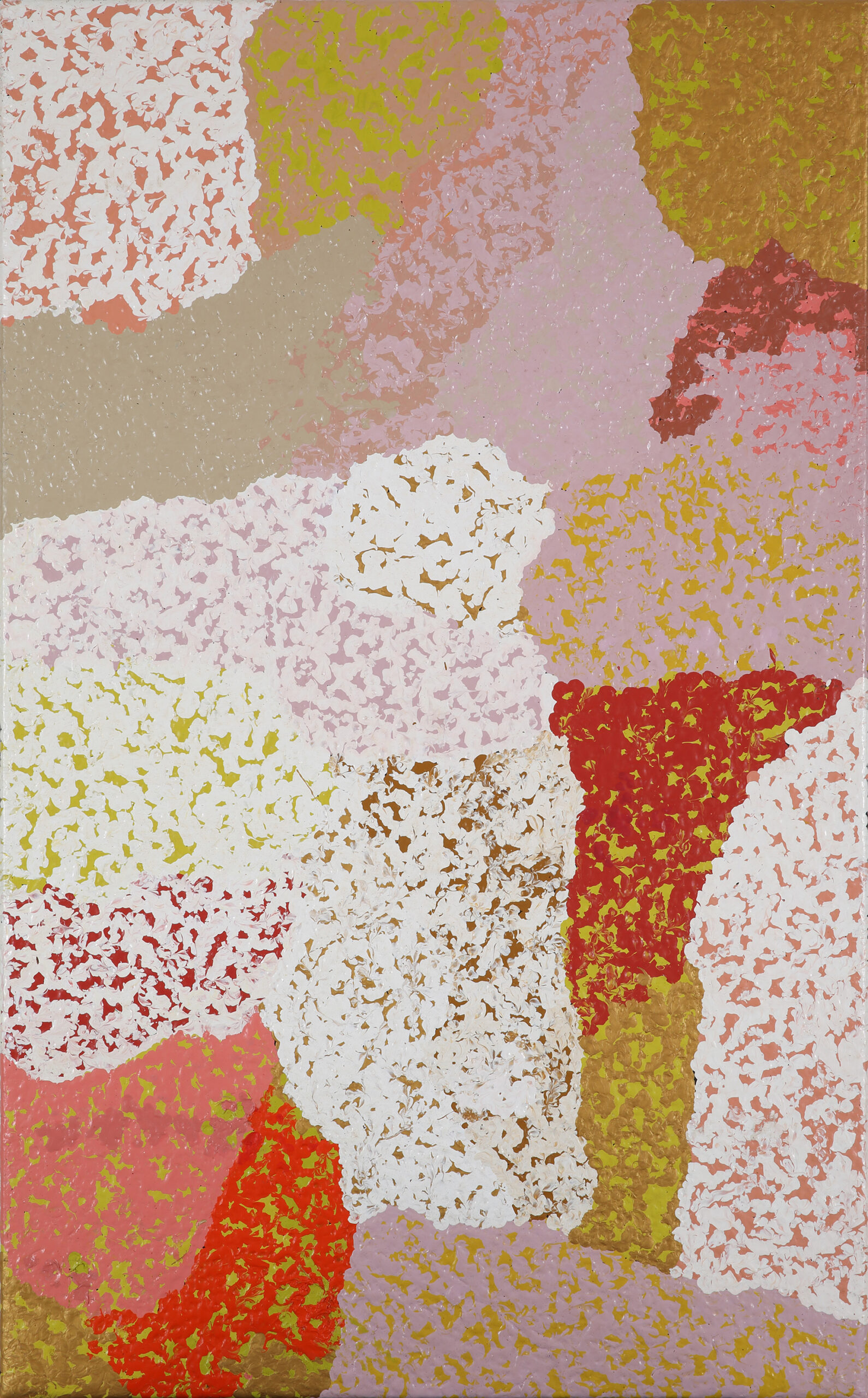
Jupurrl
$3,140.00
This one a yinta (permanent spring) in my ngurra (home country, camp), Jupurrl. It’s kakarra (east) of Kulyakartu and kayili (north) side of Wirnpa. I was a married woman when I was walking around this place, pujiman (traditional, desert dwelling) time. I married a good man. There’s lots of kapi (water) there. Lots of Yukari (green grass, vegetation). Plenty of bush tucker, pussycat and goanna. There’s no kapi when you first get there, but you dig him up and then there’s lots of kapi. We’ve got to take all the kids to that ngurra. Show them my daddy’s ngurra. There’s another waterhole, not far from there called Jakapinka. A jila (snake) made that kapi. It’s my brother’s country.
When I was a little girl, my father and mother took me around Yulparija Country, north of Manyjilyjarra Country. We used to walk around when I was a little girl. We travelled with my grandmother and all the family; we travelled with my sisters and brothers. We went from place to place, stopping in one place, hunting around and stopping in another place. We visited all the yinta (permanent springs). We could even travel on the water from a soak. I used to stay at the camp, waiting by the water, while my parents and grandparents would go out to get a lot of meat and other food. The little kids would stay home and hunt for small lizards. Then we would all travel together to another place. My grandparents really loved and cared for me when I was a little girl. They took good care of me. I was growing bigger at that time. When I grew bigger, I was able to go hunting on my own. I hunted cats and goannas. My parents still went hunting for meat for us all then.
[Later] I lost my mother and my grandmother, and then my father left us and walked into a station, but my other grandmother kept looking after me. I was still travelling with my mother’s mother when I got married [became second wife to the father of Yuwali Janice Nixon (dec.)] and had my daughter, Barli. When I was travelling with my husband and all the family we went south to Wirnpa and Kurturrara. We stayed around there for a time and then went northeast, on the tableland. During the wet season we would travel out from the yinta (permanent springs) across the tableland. I would travel with Yuwali’s mother [the first wife of Yikartu’s husband]. We would walk together, hunting as we went.
During a rainy season we were staying in one place for a while and we had a visitor from Bidyadanga. There was one missionary [Father McKelson] and two Martu men travelling with him. They asked us who we were and wrote it down on a piece of paper. Then he told us to sit down and wait for them to come back with a vehicle. From there we went into the mission.
Translation by Ngalangka Nola Taylor
At Bidyadanga Yikartu met up with a close uncle of hers and many other Martu, Juwaliny and Mangala people. She lived in both Bidyadanga and Jigalong for a period, during which she had three more daughters. During the 1980s ‘Return to Country’ movement Yikartu relocated to Punmu Aboriginal community to be closer to her home ngurra.
Yikartu often paints her husband’s country, close to Wirnpa, but also paints her mother’s, father’s and all her grandparents’ country around Lungkurangu, north of the Great Sandy Desert. Yikartu paints the jila (living water, snake) water sources running from Yulpu to Yimiri, Kupankurlu, Kurturrara and Wirnpa. Yikartu’s work has been exhibited widely across Australia and internationally, and her collaborative works acquired by the National Museum of Australia and the National Gallery of Australia.