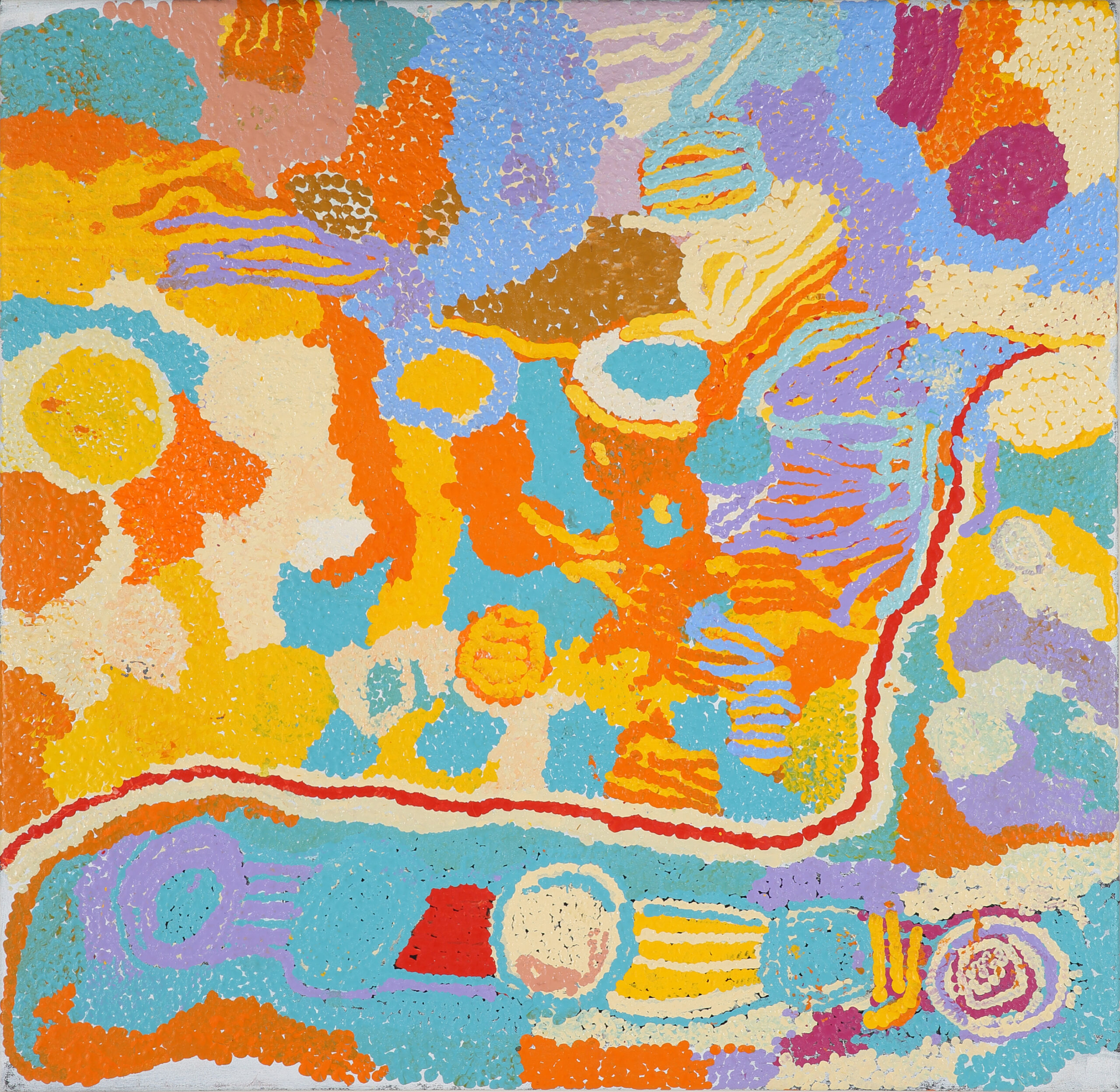
Wantili (Warntili, Canning Stock Route Well 25)
$3,210.00
Wantili (Warntili, Canning Stock Route Well 25) area, close to Parnngurr. My ngurra (home country, camp), my jamu’s (grandfather’s) country, my father’s daddy, Jakayu [Biljabu’s] daddy and my daddy’s country. Jakayu buried her father there. In pujiman (traditional, desert dwelling) days, my family and Jakayu’s family were walking round there together. Big sandhills here. Sandhill, sandhill, sandhill everywhere. Claypan there, in the middle. Good place for swimming and drinking, for hunting little kangaroo. When no water [we would] go to [the adjacent Canning Stock Route] well. When there [was] rain we stay there at Wantili. Everywhere, we been walking everywhere.
Near to Wantili, road [Canning Stock Route] going kayili (north). Long time [ago] only horses and cattle [travelled along that road], going Meekatharra and back in the cold time, gone right up to GJ (Georgia) Bore. Halfway, when he see water at Wantili, that mob would camp one night, bullock eating all the grass and men’s drinking water. One Martu been working with that mob, droving bullock. Every time he gave us meat, all the pujimanpa (desert dwellers).
I was born [around] Karanyal and Martilirri (Canning Stock Route Well 22) in the parna (ground, earth), only claypan. My jamu (grandfather) [was also] Jakayu [Biljabu’s] father, my father’s daddy. My mummy born long way, near to Wikirri (Midway Well) area. My father born Pitu (Separation Well). I’m biggest one [eldest of five siblings]; me, Neil, Ivy, Gladys, then Caroline. My sister Gladys was born Wantili, Ivy born Georgia Bore (Pitarny), Caroline was born in Jigalong [Mission]. We walked around together [as we were] growing up.
As a child, Ngamaru Bidu walked around with her family, living a pujiman (traditional, desert dwelling) lifestyle. In 1963 Ngamaru saw a whitefella for the first time near Wiirnukurrujunu rockhole; surveyor Len Beadell grading a road across the desert as part of a military weapons testing program. Shortly after this meeting Ngamaru, along with the other 28 Martu she had been travelling with, was tracked and pursued by the Native Welfare Department. The group was eventually persuaded to move to Jigalong mission to join their relatives that had already moved in from the desert.
They chased us, long way – me, Ivy, and Kuru [Gladys] ran away with Mitchell and Teddy Biljabu. Kumpaya, Bugai and my mother ran away quick too. Landrover he picked us up for Parngurr, all the lot, [driving on the] track for Jigalong. Family all coming in. I came in for first time [in a vehicle]. I was naked one, put a blanket for kurnta (shame). I was living there in Jigalong with my mummy and family. I was working in the dining hall, making bread for kid. I met my nyupa (spouse), Mr Booth, and had a son, Ned Booth.
Together with their children, Ngamaru and her husband later moved to Warralong and then Punmu Aboriginal communities before settling in Parnngurr Aboriginal community (Cotton Creek), where Ngamaru continues to live today. Ngamaru has painted with Martumili since its inception in 2006.