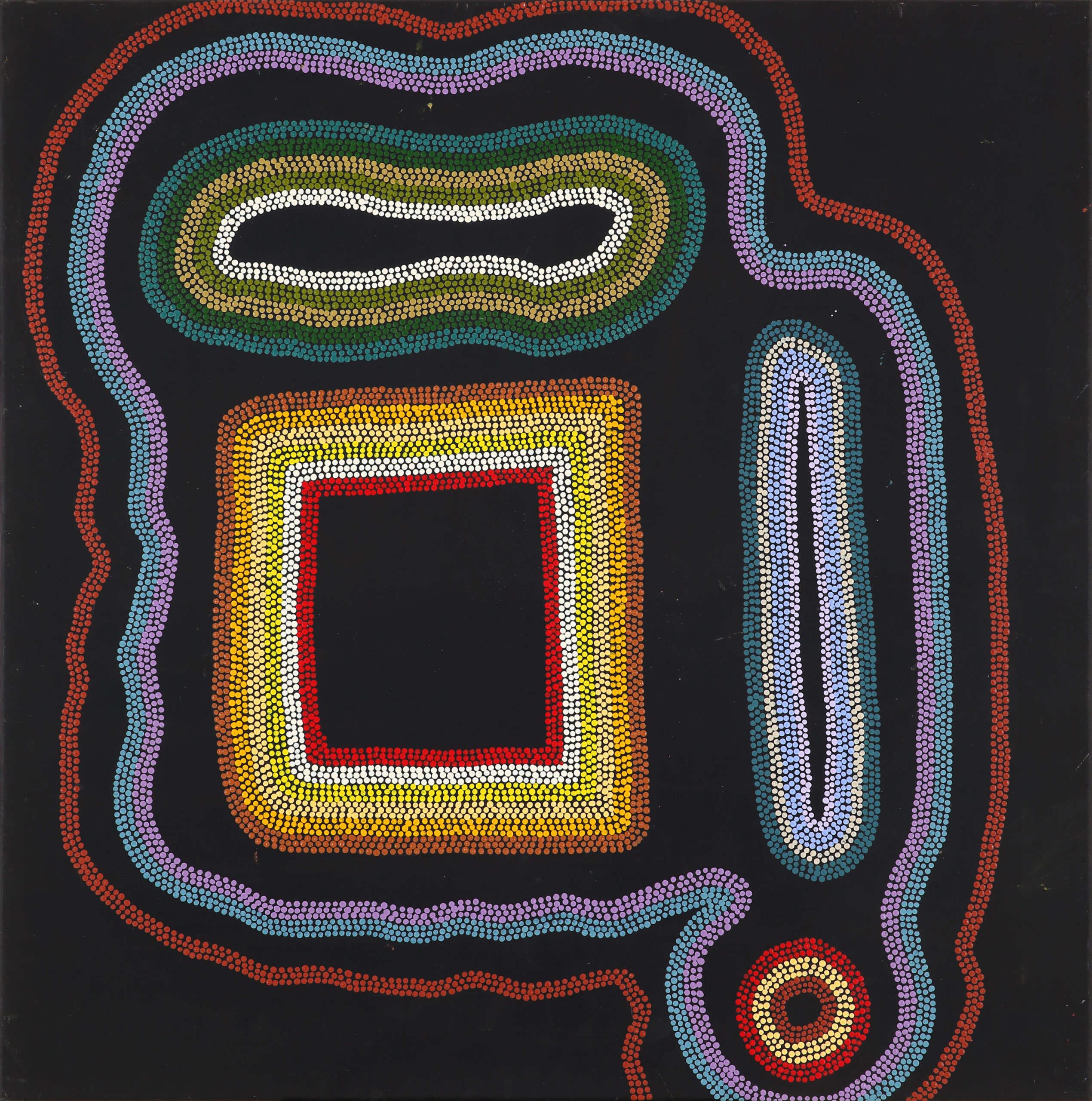
Wati Kutjara Wanampi
$1,510.00
Margaret Donegan has painted the Tjukurpa of her father, the late Mr.Donegan, from an important site known as Pukara, south-west of Irrunytju (Wingellina) in Western Australia. It is a story of Wati Kutjara Wanampi (two male water serpents) -a father and son – who are living at a waterhole. According to the story, Anangu tjuta (lots of people) went to that rockhole for the kapi (water), which is said to taste sweet. This upset the father, and he told them to go back to their own country. Once the people left, the father and son travelled to Willuna, where they camped for weeks. They then return to Pukara. One day they were sleeping but were awoken by a loud buzzing sound. The Minyma Punpunpa (the female flies) had been attracted to the honey grevillea plants found near the waterhole. It prompted the father and son to get up and go to collect the honey from the plants. It is there that the Wati Mututa (male black ants) appeared. They speared the son in his side. When the son started vomiting, he produced the seeds of all the different varieties of honey grevillea plants that are still found there today. They include kaliny-kalinypa, ultukunpa, piruwa and witjinti.
Margaret Donegan is the daughter of renowned artist Jimmy Donegan. As a very young girl she lived at the Adelaide Children’s Hospital, before moving to Amata where her father worked as a stockman. During the late1970s and the Homeland Movement, she and her family moved to Pipalyatjara to be closer to traditional homelands. She attended the Spinifex School, a small school for the local Pipalyatjara children. As an adult, she moved to Papulankutja (Blackstone). It was here she began her career as a painter and art worker. Both Margaret and her mother were involved in creating the Tjanpi Toyota; a life-size replica of a Toyota Landcruiser. Tjanpi Toyota won the National Aboriginal and Torres Strait Islander Art Award in 2005. Today Margaret lives with her family in Kalka where she continues to build her art practice in painting, punu,and weaving. Her art is inspired by Tjukurpa, including those associated with Minyma Kutjarra, Wati Ngintaka and Kungkarrakalpa. She is also a dedicated art worker at Ninuku Arts Centre.